Spectra TFinity Series.
Spectra TFinity is the top of the Spectra Logic line — the deployment tier for national-laboratory and hyperscale-research preservation, scaling to multi-exabyte capacity within a single library. One capability separates it from everything else described here: tri-media support, meaning LTO, IBM TS11xx, and Oracle T10000 drives may be intermixed in one system.
Exabyte scale · Spectra EDGE Partner · Authorized reseller
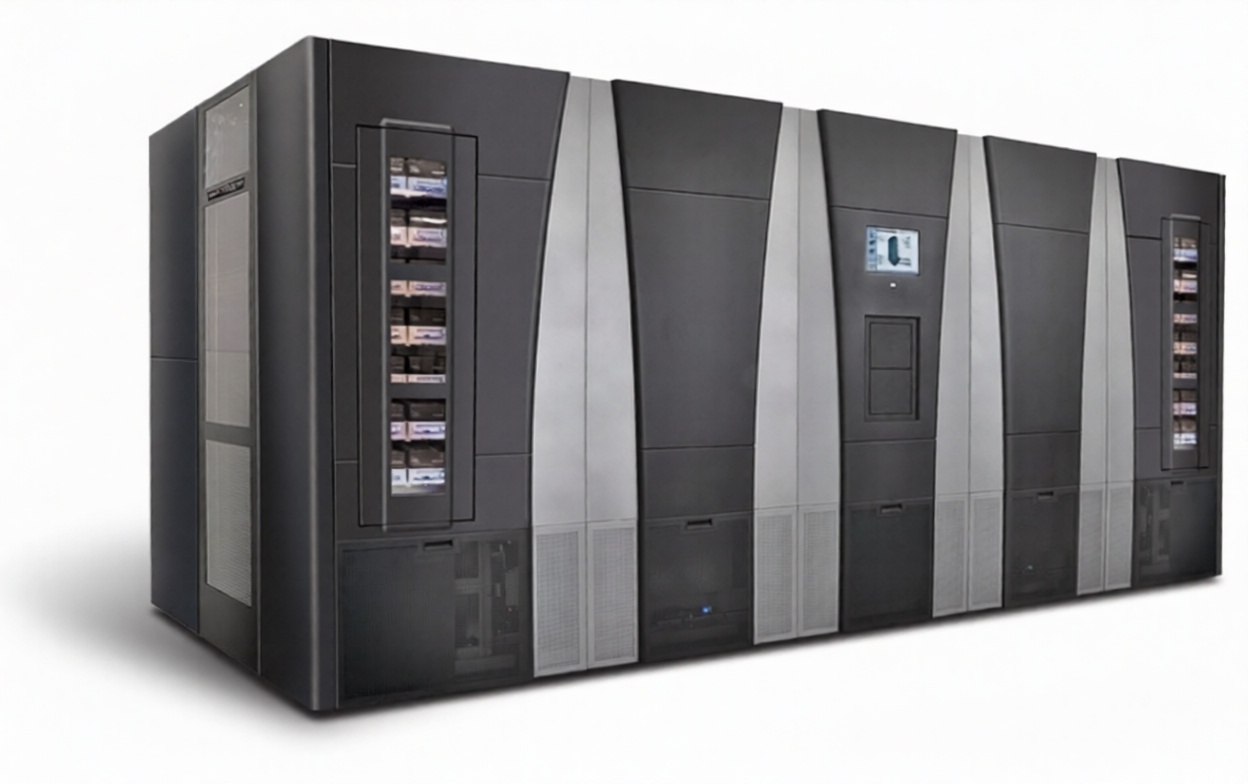
Built for exabyte horizons.
Tri-media intermix is the property that matters most for institutions carrying a long media history, and it is rarely the headline figure that sells the library. A site holding decades of TS11xx or T10000 media alongside a current LTO estate can consolidate into one system and migrate on its own schedule, rather than maintaining parallel libraries and parallel maintenance contracts through a transition that may take years. Generation migration happens inside a library the institution already owns.
Capacity scales by frame across a very wide range. A three-frame TFinity Plus carries 1,800 LTO-10 slots and 72.0 PB native; a forty-five-frame configuration carries 56,400 slots, 2.2 EB native, up to 168 drives, and 241.9 TB/hr. Dual robotics and up to sixteen SLS partitions support the concurrent workloads that consolidation at this scale implies, and Spectra states the smallest footprint of any enterprise library in its capacity class.
Operationally the TFinity carries the same discipline as the rest of the line — Spectra Vision camera verification, certified media lifecycle tracking, automated cleaning, queued ejects, and encryption through BlueScale Standard, BlueScale Professional, and KMIP — with N+1 redundant power supplies available for sites whose facility requirements demand them.
Capacity at forty-five frames.
The figures below give the TFinity Plus at three frames and at forty-five, and are stated for LTO-10 and for TS1170 media, since the library accepts both. Unique Checksum sizes capacity against retention horizon and drive mix against the media generations an institution already holds — at this scale, the existing media estate usually constrains the configuration more than the capacity target does.
| Specification | Value |
|---|---|
| Maximum slots (45-frame) | 56,400 (LTO-10); 42,930 (TS1170) |
| Maximum native capacity (45-frame) | 2.2 EB (LTO-10); 2.2 EB (TS1170) |
| Maximum compressed capacity (45-frame) | 5.6 EB (LTO-10); 6.45 EB (TS1170) |
| Three-frame configuration | 1,800 slots; 72.0 PB native; 24 drives |
| Maximum native throughput | 241.9 TB/hr (45-frame) |
| Maximum compressed throughput | 725.8 TB/hr (LTO); 544.3 TB/hr (TS1170) |
| Tape generations | LTO-6 through LTO-10, LTO-7 Type M; TS1150, TS1155, TS1160, TS1170 |
| Media intermix | Tri-media — LTO, IBM TS11xx, and Oracle T10000 in one library |
| Maximum drives | 168 (45-frame) |
| Robotics | Dual robotics; roving TeraPack with queued ejects |
| Maximum partitions | 16 (SLS) |
| Encryption | BlueScale Standard; BlueScale Professional; KMIP |
| Power | 1,275 W maximum (base plus 24 LTO drives); N+1 redundant supplies available |
| Environment | 16–32 °C allowable, 16–25 °C recommended; 20–80% RH |
| Reliability | MTBF 250,000 power-on hours; MCBF 3 million cycles; MTTR 3 minutes (hot-swap) |
Figures are Spectra Logic published specifications for the maximum configuration of this library family using current tape generations.
Where media generations converge.
The TFinity is specified where the preservation requirement is measured in exabytes and in decades: collaboration-scale experimental data, national-laboratory holdings, and long-horizon institutional archives that will outlive several tape generations.
For institutions carrying mixed media, tri-media capability is frequently the deciding specification rather than raw capacity — the question is not how much the library holds but whether it can hold what the institution already has while it migrates. That makes the TFinity conversation different in kind from the T950 conversation, which is about frames and workloads. Here it is about media estate, migration schedule, and how long two generations must coexist. Institutions at this scale are also generally operating their own enclaves and their own compliance regimes, which shapes how the tape tier is integrated as much as any capacity figure does.
The full library family is set out on the Spectra Logic page; the next tier is Spectra Stack.
Specifying at exabyte scale.
Unique Checksum begins an exabyte-scale specification with the media inventory rather than the capacity target: what generations the institution holds, what must remain readable, over what horizon, and what the migration path costs in drives and in time. Capacity follows from that; it rarely leads.
For a Spectra TFinity Series conversation — configuration, capacity planning, media generation, or integration with an existing storage platform — write to sales@uniquechecksum.com.